Context
Access had grown rapidly through acquisition — hundreds of products, each with its own design language, tech stack, and customer experience. While "Access Workspace" offered a unifying entry point, technical and cultural barriers meant many divisions struggled to adopt it.
As UX Manager for the Central Access team, I helped steer the multi-disciplinary Evo team responsible for defining what the "Access experience" should look and feel like across divisions.
Led cross-functional alignment and delivery across multiple divisions, working with the CEO, CSO, CPEO, and other cross functional leaders.
Core skills: design leadership, team coaching, stakeholder management, user research, vision articulation, usability testing, adoption strategy.
It began with a simple vision document from a new team member — an idea that resonated with our incoming Chief Product & Engineering Officer. It reminded us that innovation can come from anywhere.
Action
Working closely with the CPEO, product, and engineering leaders, we formed a small experimental team to test new, lightweight ways of bringing products together.
Our focus shifted from grand redesigns to pragmatic adoption: what could we deliver quickly, visibly, and in a way that every product could join in?
The Access Button
We started with a deceptively simple concept — the Access Button.
A small, universal entry point that connected products into a shared experience.
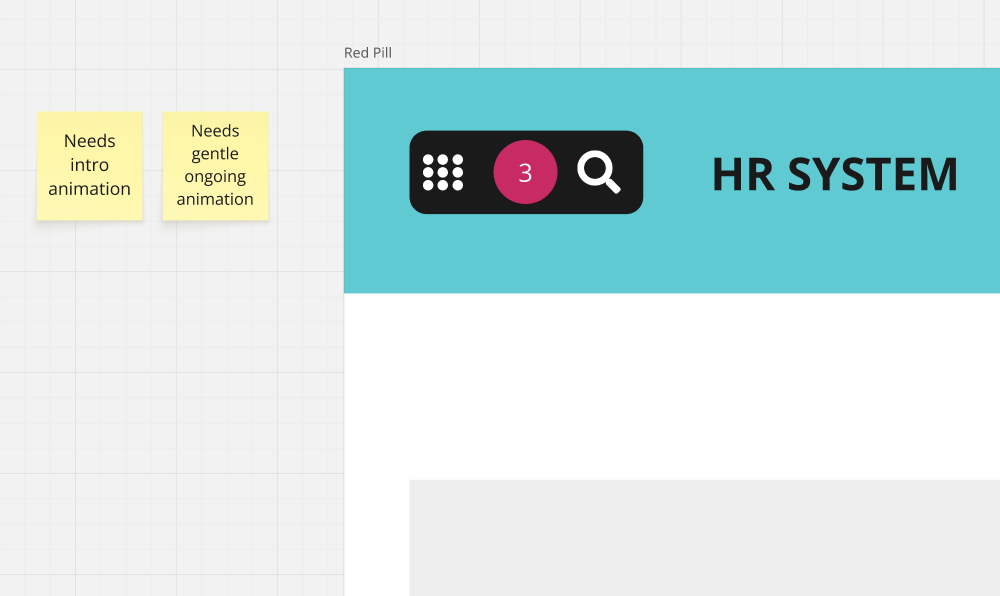
The first sketch of the Access Button in Miro, ideated during an all-day workshop, including our CPEO.
- • Prototyped and tested early versions quickly and iteratively.
- • Delivered UI guidelines, motion studies, and developer handoff specs.
- • Addressed adoption barriers through clear documentation and evangelism across product squads.
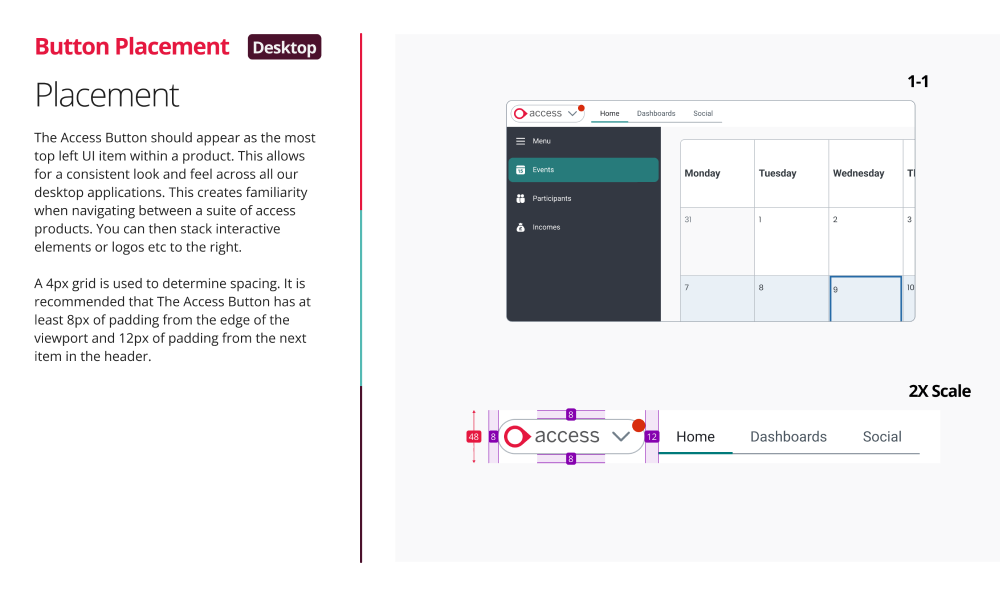
Documentation guidelines for divisions, created by the team.
Within 2-3 quarters, over 70 products had integrated the button — more than twice the level of cross-product adoption achieved in the previous five years.
Copilot
Next, we introduced Copilot, bringing conversational AI into the core Access experience.
- • Conducted iterative user testing to understand how customers preferred to "just type into the box" rather than navigate menus.
- • Defined standard success metrics (Adoption Rate, DAU/MAU, Active User Rate) to measure engagement.
- • Piloted across key divisions to prove value and build momentum.
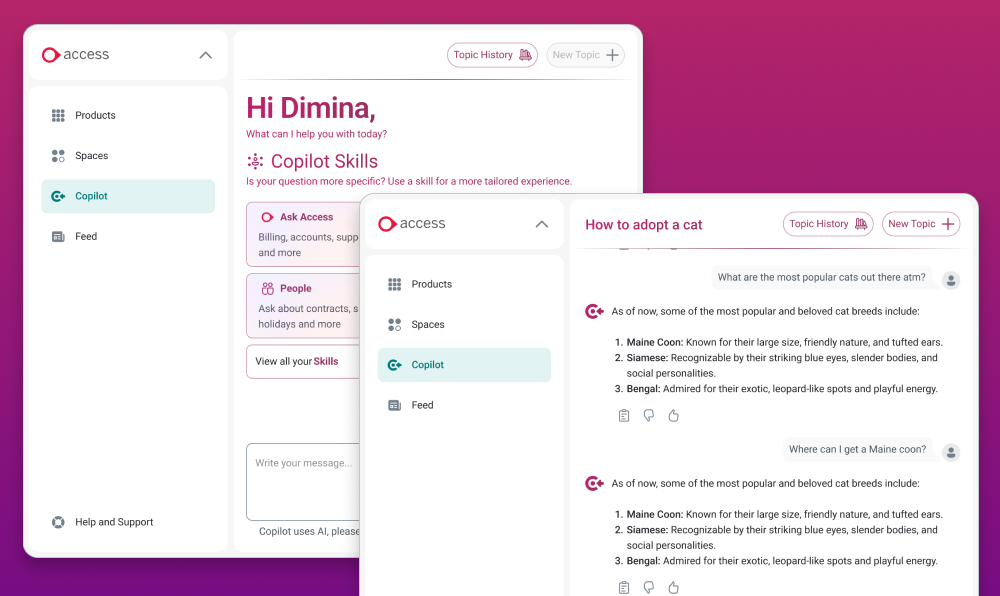
Copilot, the core conversation-based Access AI experience.
Feed & Mobile
We also delivered the first Evo Feed, surfacing actionable insights and notifications from multiple products, paired with AI-driven "Essentials" to keep users informed.
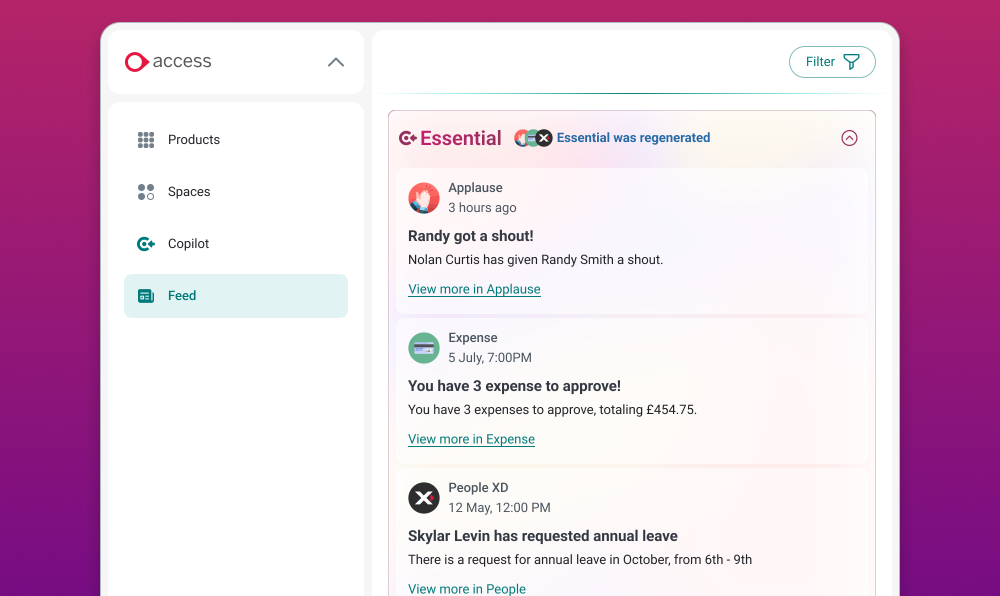
The Evo Feed, surfacing actionable insights and notifications from multiple products, paired with AI-driven "Essentials" to keep users informed.
In parallel, the Evo Mobile App extended these capabilities beyond the desktop, ensuring continuity across devices.
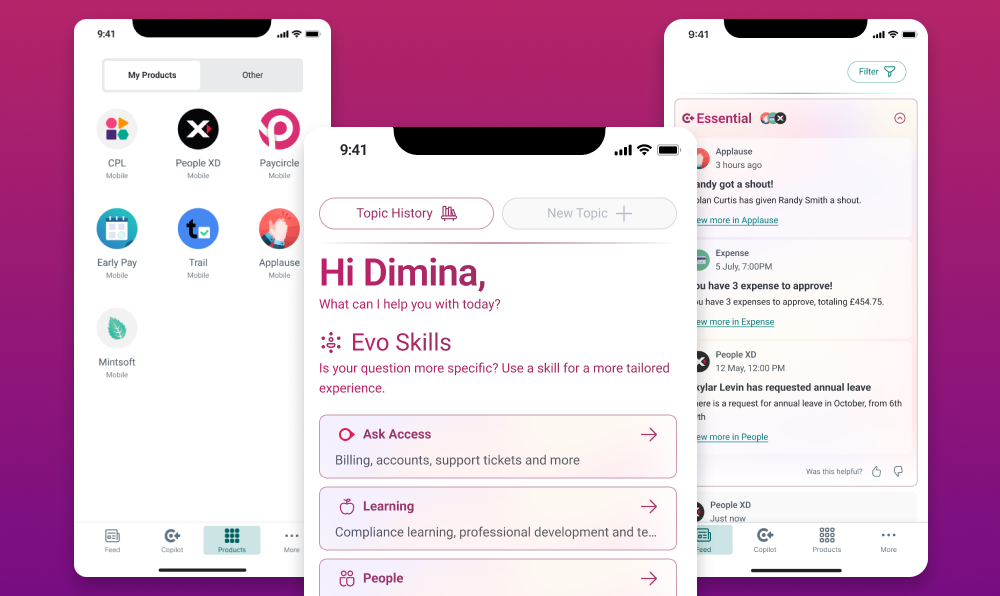
The Access Evo mobile app, extending the core Access experience to iOS and Android.
Across all streams, more than 500 usability tests informed each decision — grounding every release in real user behaviour.
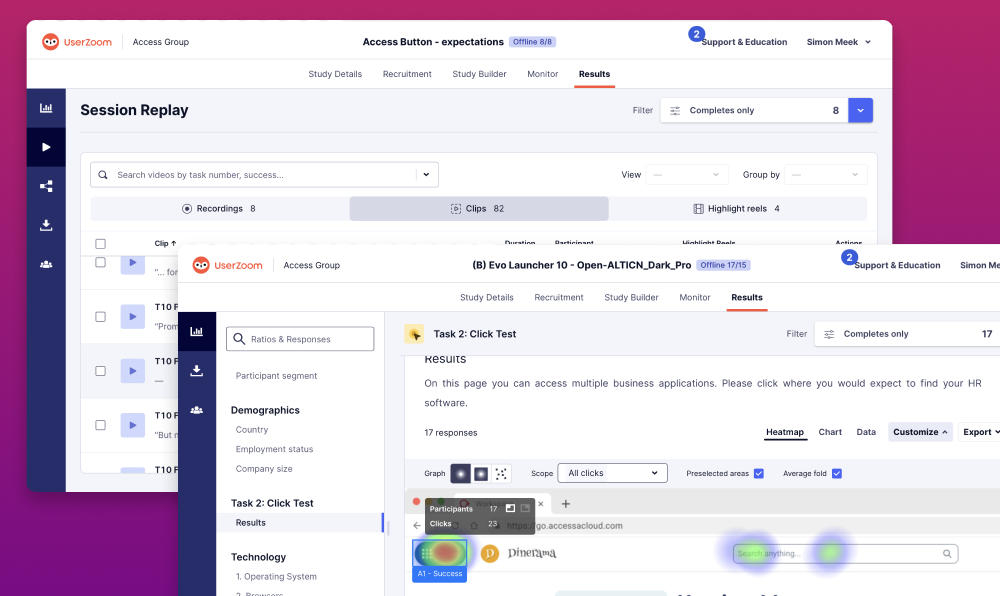
One of 500+ usability tests conducted during the project.
Impact
- • Unified Experience: The Access Button became a visible and widely-adopted anchor point for the Access experience, used by 70+ products within two quarters.
- • AI-Enabled Discovery: Copilot introduced natural-language access to product knowledge, reshaping how users interacted with the platform.
- • Customer Clarity: The Evo Feed centralised what mattered most — notifications, insights, and next steps — directly within each user's daily workflow.
- • Cultural Shift: From one UX vision to a company-wide movement, Evo demonstrated how small, well-designed steps can drive organisation-scale change.